Start Here

In June 2015, the Unicode Consortium blessed us with a handful of new emoji including a burrito 🌯 and a cheese wedge 🧀. Perhaps the most think-piecey new addition to Unicode 8.0 was the inclusion of various skin-tone options for the hand-gesture and people emoji, which sparked many interesting conversations about who opts to use the various skin tones and why. Andrew McGill wrote a fascinating piece in The Atlantic earlier this year that explores the question of why white people don't use the white emoji.
With all this going on, it's easy to see why I, and many people, overlooked the upside-down smiley face emoji at the time. I only realized 🙃 existed months after it became a part of my emoji options when a younger coworker IMed me what I interpreted to be the emoji equivalent of the expression "Oh, well." I googled 🙃 and I was hooked.

Mom
I've written about the new internet slang meaning of mom a couple times now. In case you're unfamiliar with this sense, mom is generally used by young women to express admiration for another woman (who may or may not be an actual mom). It started out on social media, and you'll often find it in the replies or comments on Twitter or Instagram. It's even spread to network television; mom was featured in a very GIFable scene in Scream Queens.
Full Archive
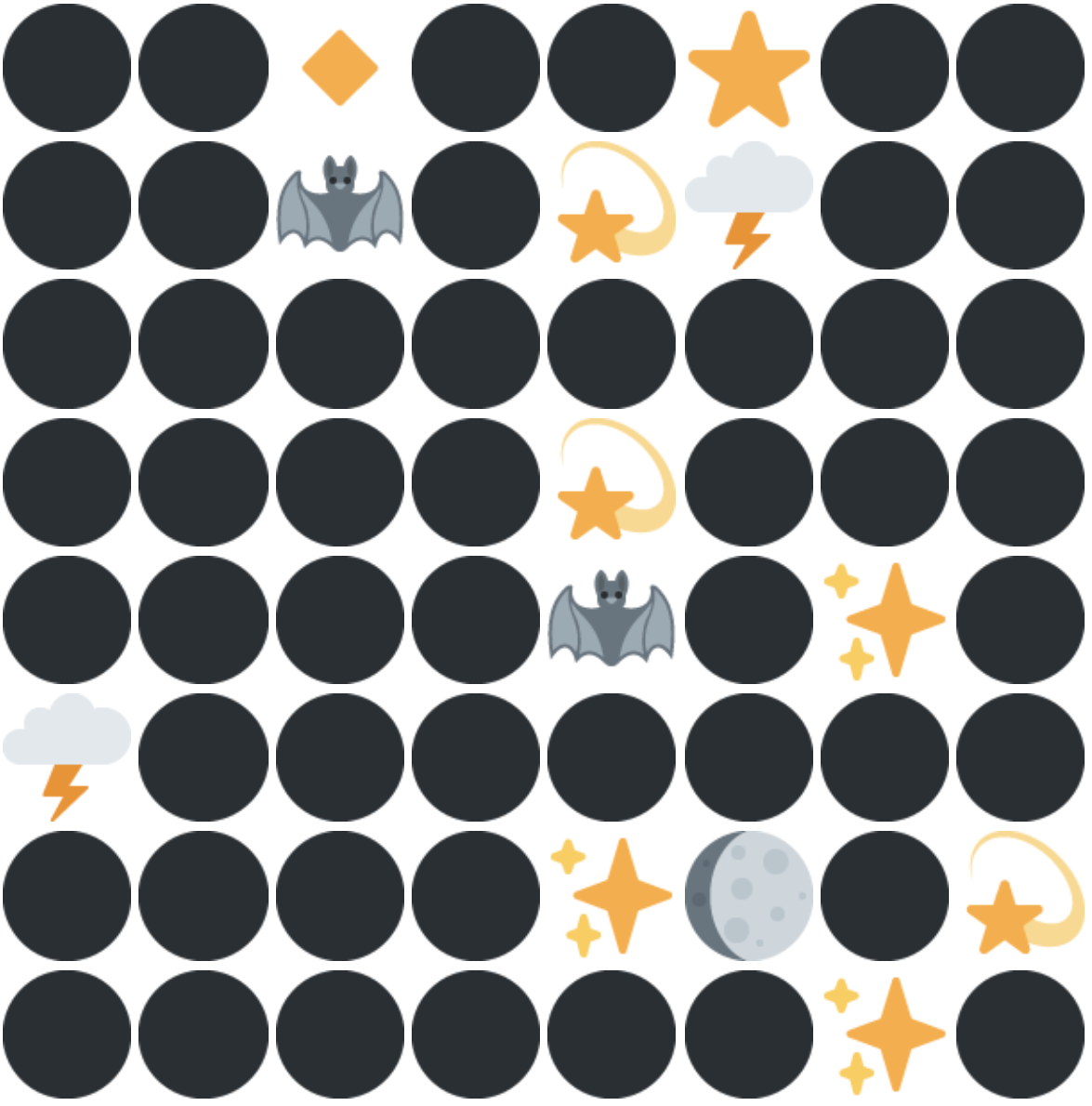
I made an emoji-sky generator on Glitch with Andrea Gaither and Jez Smith. Andrea is an amazing engineer and made the code actually work and display Twemoji (I think the flatness of Twemoji designs works really well for emoji grid art). Jez swooped in later to tidy everything up (he really cares about code being as efficient and elegant as possible). It's based on the glorious Emoji Garden by Monica Dinculescu.
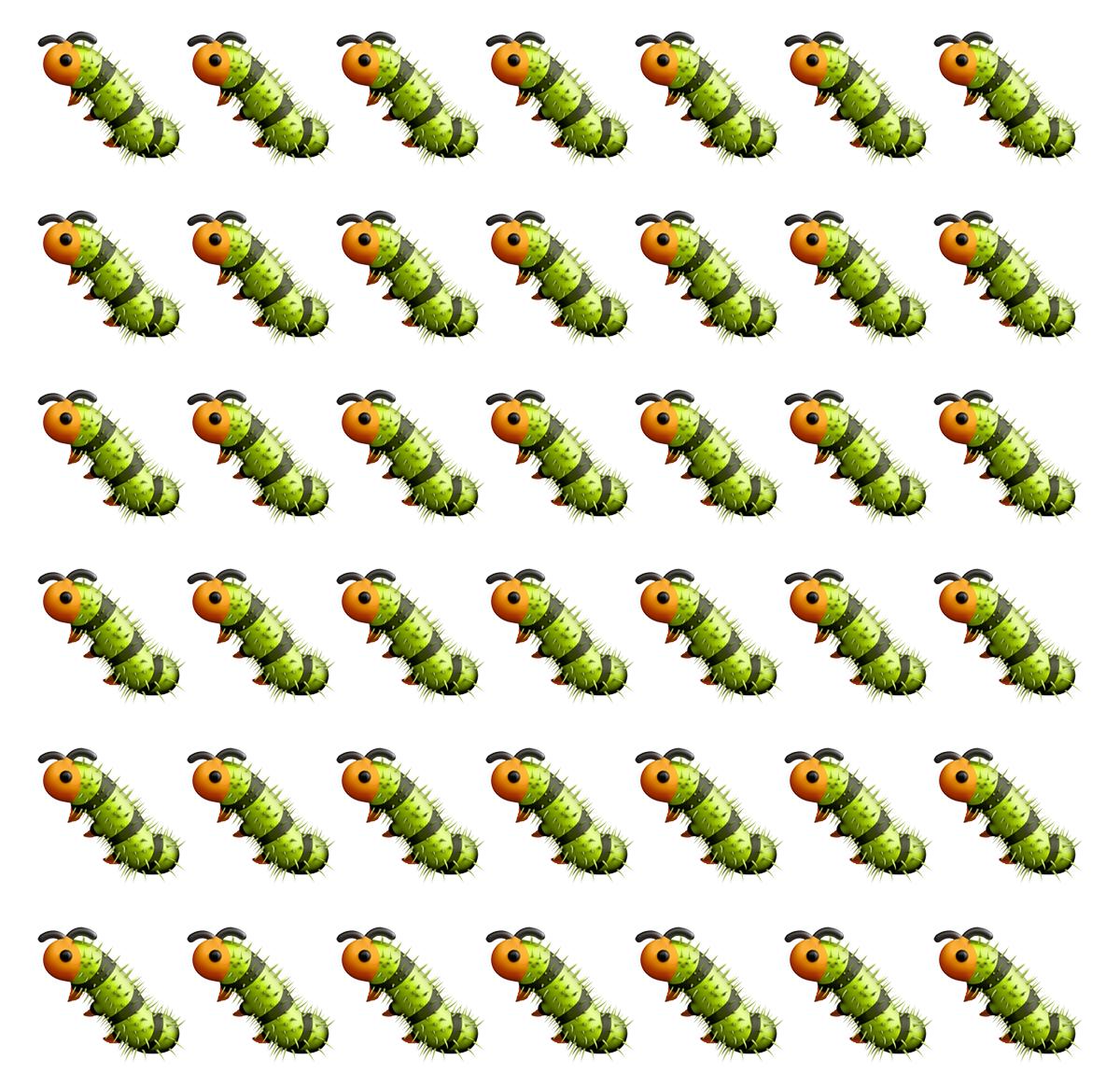
🐛I wrote a bug emoji review, because this emoji is mostly adorable.🐛
I was surprised when I first learned that this emoji was called the bug emoji, because most platforms display this particular emoji as a caterpillar. When someone says "bug," I don't imagine a caterpillar. To me, the prototypical bug has more of a dark bulbous body.
It's Word of the Year (WOTY) season.
The last group that weighs in on WOTY is the American Dialect Society (ADS), which has been selecting WOTYs since 1990. This vote is made by a room full of linguists, so the words chosen often have an element of linguistic interest to them. Past words have included Because X, #BlackLivesMatter, and gender-neutral singular they.
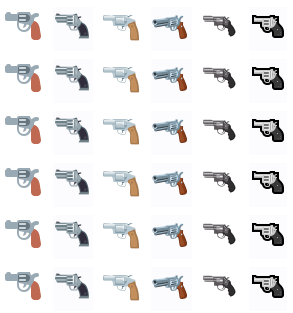
There's a lot to unpack when discussing the gun emoji. In Part 1 of this series, I looked at the raw counts of hits for various emoji that come before and after the gun emoji. Though that's fascinating in its own right, I knew that ultimately I wanted to filter out the most common emoji and calculate the pairings using normalized relative frequencies to further chip away at the question of what comes before and after the gun emoji.
I also touched on three reasons why the gun emoji is so interesting to study: it's directional, it looks different across platforms, and its meaning is culturally "loaded." In this post I want to focus on the last of these reasons because it's such a complex issue.
When I learned about emoji reviews, I got very excited. Not only are these a delight to read (I really like the snake emoji review), but they also present a great visual example of how the variance in emoji display across different platforms can lead to miscommunication.
If you're a person who is sometimes asked by journalists "Will emoji replace English!?" (I am), this is one more example you can point to of how difficult it is to have some sort of universal understanding, even within one Unicode codepoint.
In case I wasn't clear: 🚨Emoji will not replace English🚨
But they are a lot of fun. Here's my first-ever emoji review.

The gun emoji is of particular interest to me because it's directional. By this I mean that whether an emoji comes before or after the gun emoji impacts the meaning. To put it simply, order very much matters when we're talking about who is being shot and who is pulling the trigger.
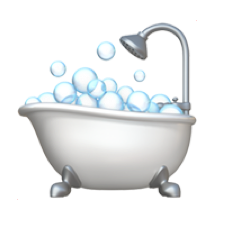
Over the last couple of years, I've been hearing the term self-care a lot, and it's clear to me that its usage falls on a spectrum. On one end, it's used earnestly in the context of self-preservation and healing from trauma, and on the other end it's used as a marketing label slapped on bath bombs, face masks, and body lotions.
Curious about its roots, I did some research.
Publicity Stunt or Intellectual Exercise?
Every year several dictionaries name a Word of the Year (WOTY). Cynics might say this is a publicity stunt, but I think it's a fascinating intellectual exercise and I love that at the end of the year, lexicographers have an excuse to deeply reflect on words that were significant over the past 12 months. Even more than that, I love that various WOTYs give people who don't usually spend their days obsessing over words the opportunity to engage with language in a meaningful way.
In June 2015, the Unicode Consortium blessed us with a handful of new emoji including a burrito 🌯 and a cheese wedge 🧀. Perhaps the most think-piecey new addition to Unicode 8.0 was the inclusion of various skin-tone options for the hand-gesture and people emoji, which sparked many interesting conversations about who opts to use the various skin tones and why. Andrew McGill wrote a fascinating piece in The Atlantic earlier this year that explores the question of why white people don't use the white emoji.
With all this going on, it's easy to see why I, and many people, overlooked the upside-down smiley face emoji at the time. I only realized 🙃 existed months after it became a part of my emoji options when a younger coworker IMed me what I interpreted to be the emoji equivalent of the expression "Oh, well." I googled 🙃 and I was hooked.
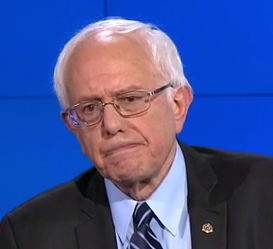
I Always Have That Look on My Face
Fusion ran a story with an amazing headline this week: "A Visual History of Bernie Sanders' Resting Bitch Face."
This headline was sparked by an interview with Bernie Sanders on Face the Nation. The host mentions that Sanders had a "stoic" look on his face when Hillary Clinton spoke at the DNC, and then asks him what was going through his mind at the time. Sanders replies: "I always have that look on my face. You know, it's nothing new. I'm not always a smiley kind of guy."
I was a sometimes listener to the podcast Reply All who has been converted to an always listener because of a recent episode called "Vampire Rules." Often at the end of episodes there's a segment called Yes Yes No, where PJ Vogt and Alex Goldman millennial-splain the internet to their boss Alex Blumberg. In this episode's Yes Yes No, the following tweet is explained.
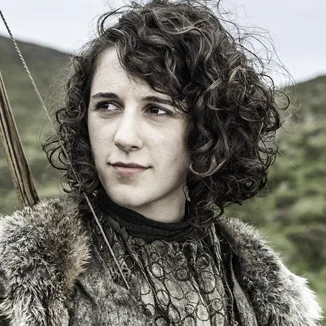
Last night's episode of Game of Thrones was harrowing, to say the least. However, amid all the darkness, I had a moment of levity as a linguist when Meera Reed uses contrastive focus reduplication (sometimes also called lexical cloning or the double construction).
As Meera is packing up her things, she explains to Hodor what's happening: "We can go home now, Hodor. Well, maybe not home home, but somewhere that isn't a cave."
What's Reduplication?
If you're not already familiar with reduplication, here's quick linguistics lesson: in English (and other languages) sometimes words, parts of words, or phrases are repeated to create a novel element of meaning. This element of meaning can range from an added connotation to an entirely different sense.
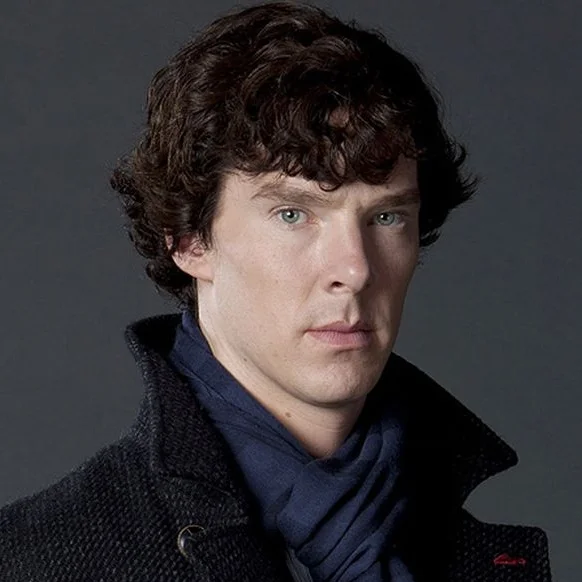
Last week I interviewed linguist Gretchen McCulloch at the Dictionary.com offices in Oakland, California. We discussed many pop-linguistic topics, including the role of memes in our culture, the lowercasing of the term internet, and her upcoming book. I was first introduced to Gretchen's work through her Benedict Cumberbatch piece on the Toast, and in our conversation I learned that while she might possess the skills to summon Wimbledon Tennismatch, she is more excited by the linguistic variations of his name than by his acting work.
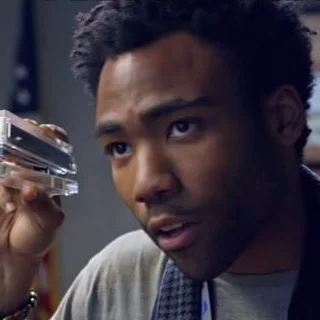
DOES THE MATH CHECK OUT?
Since seeing the Martian, my friends and I have been non-stop quoting a line said by Donald Glover: "I've done the math. It checks out."
In my last post, I wrote about the nature of a subtweet, and how you can actually subtweet outside of Twitter, in the *~real world~*. In researching that post, I came across an adjacent topic. That is, what is the opposite of a subtweet? For those of you familiar with Twitter, the answer is no surprise. It's an @ (pronounced mention). For the purposes of this post, let's define subtweet. The purest and "most correct" form of a subtweet is a passive aggressive tweet that doesn't mention the subtweetee's handle (by typing @ followed by a user name). This is up for debate, though many websites tell celebrities who explicitly name the target of their subtweets that they're doing it wrong.
There are memes in response to subtweets that all go something like this: "I guess yo @ button must be broke." It turns out you can drop the word "button" from this sentence.
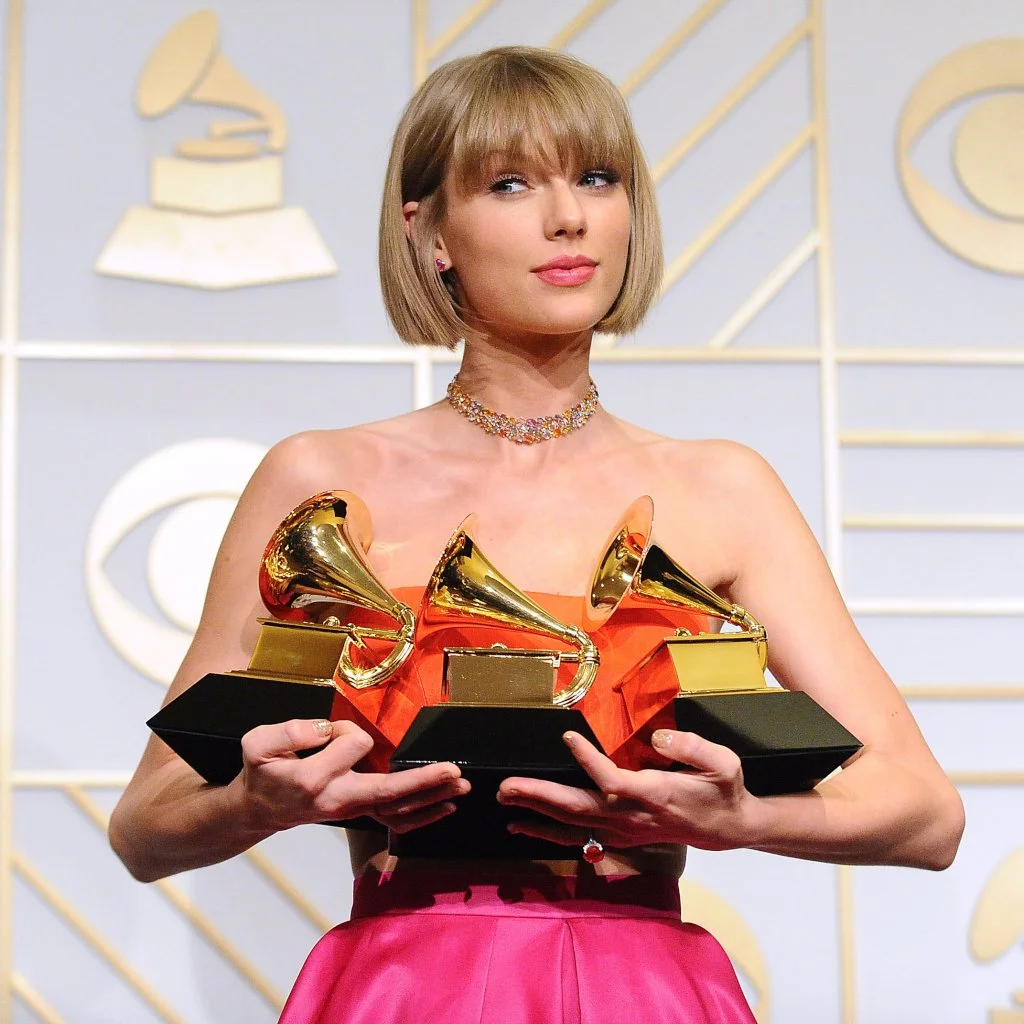
Last week at the Grammy Awards, Taylor Swift gave an Album of the Year acceptance speech that not-so-subtly called out Kanye West for lyrics in his latest album. For the record, his lyrics are: "I feel like me and Taylor might still have sex / Why? I made that bitch famous." Actually, she didn't call him out for the suggestion that they might "still have sex," but rather for the idea that he made her famous. To her, that was the true offense. There are discussions to be had about how this sort of beef in the music industry is actually good for both of their careers, but this is a blog about words, and not about PR. What I found interesting about this whole exchange was the way in which the press, or Slate in particular, described Taylor Swift's speech: "Watch Taylor Swift subtweet Kanye West while accepting her Album of the Year Grammy."
Slate's tweet, which is also the title of the article that appears on Slate, uses the word subtweet to refer to an utterance from the real world that comes from an actual human mouth, and not from fingers typing into an app. I had never encountered this before so I decided to investigate. First things first.
Mom
I've written about the new internet slang meaning of mom a couple times now. In case you're unfamiliar with this sense, mom is generally used by young women to express admiration for another woman (who may or may not be an actual mom). It started out on social media, and you'll often find it in the replies or comments on Twitter or Instagram. It's even spread to network television; mom was featured in a very GIFable scene in Scream Queens.
The gun emoji is of particular interest to me because it's directional. By this I mean that whether an emoji comes before or after the gun emoji impacts the meaning. To put it simply, order very much matters when we're talking about who is being shot and who is pulling the trigger.